
YouTube Shorts Algorithm 2026: How to Get Views
Shorts get nearly 70 billion daily views on YouTube. Yet most creators watch their Shorts sit at 0 views, wondering what went wrong.
Here's the truth: the Shorts algorithm operates completely differently from long-form. Strategies that work for regular videos fail on Shorts. In 2026, these two systems are fully separate.
Shorts vs Long-Form: Different Systems
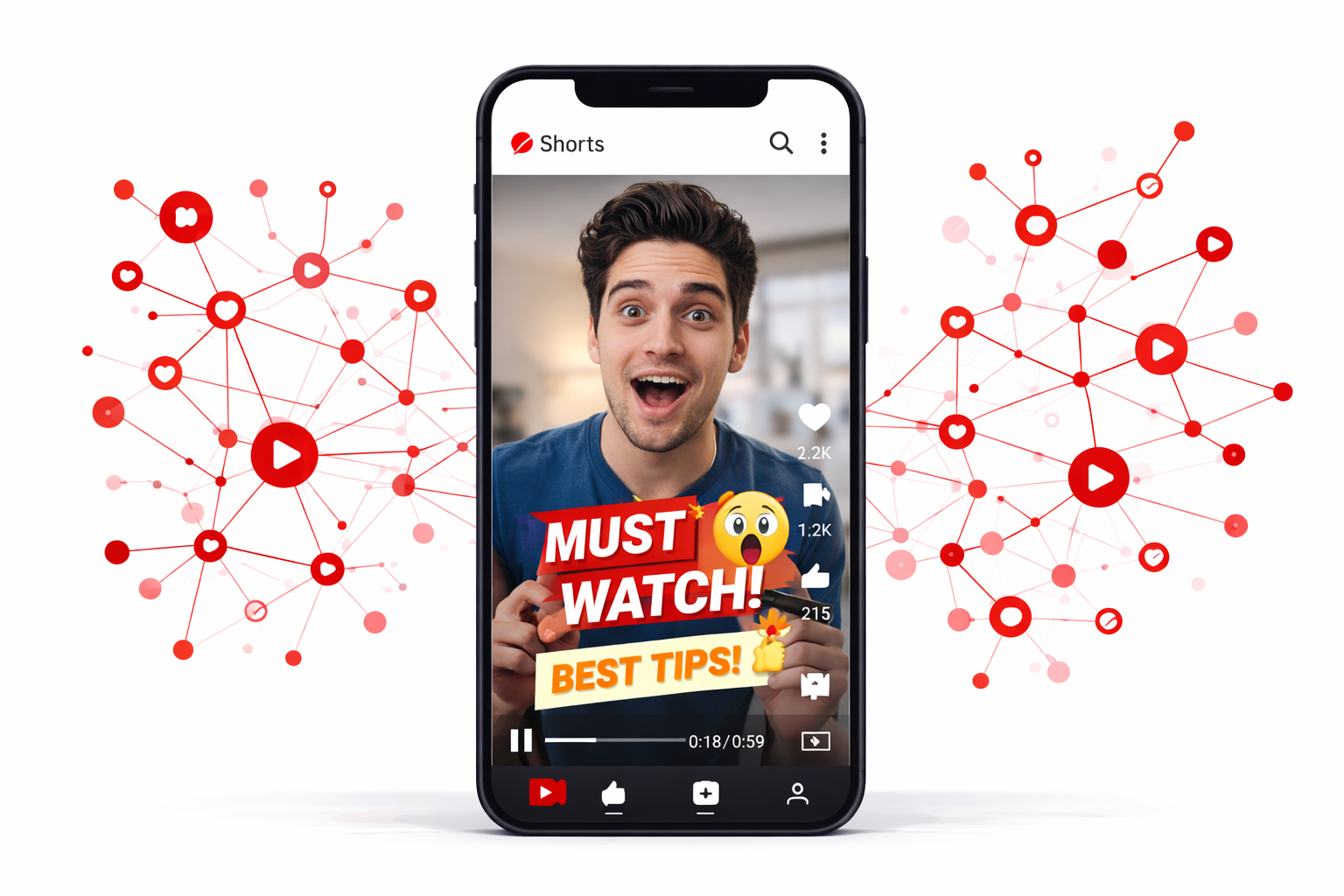
Stop treating Shorts like mini long-form videos. They're different products with different algorithms.
Discovery method: Shorts use swipe-based, passive discovery. Long-form uses click-based, active discovery.
Primary metric: Shorts prioritize watch duration percentage. Long-form prioritizes total watch time plus CTR.
Viral timing: Shorts can go viral weeks or months after posting. Long-form peaks in 24-48 hours.
View counting: Shorts require viewers to actually watch. Long-form counts a view when the video loads.
YouTube separates Shorts and long-form in watch history. Someone discovering you through Shorts won't automatically see your long-form recommendations. The viewing behaviors are different.
How Shorts Distribution Works
Every new Short goes through testing phases. First, it gets shown to a small test audience—even your channel's first Short gets distribution. The algorithm measures performance against benchmarks. Do viewers watch? Do they swipe away?
Strong metrics trigger gradual expansion to larger audiences. A Short can keep gaining traction for months through ongoing testing with new audience segments.
Delayed virality: Unlike TikTok's immediate viral potential, Shorts can explode weeks after posting. A Short that flopped in week one might go viral in week six. Don't delete underperforming Shorts—they may find their audience later.
📊 Analyze your Shorts performance. GeniusTube breaks down your Shorts metrics—swipe rate, completion, and engagement—so you know what's working. Get your free analysis →
The Ranking Factors That Matter

Watch duration percentage is most important. Not total watch time—watch percentage. A 30-second Short with 85% completion ranks higher than a 60-second Short with 50% retention.
Your target: 80%+ average view percentage. Below 70%? Your Short won't expand beyond initial testing.
Swipe-away rate is Shorts' version of click-through rate—inverted. Low swipe rate is good. High swipe rate kills distribution.
The 1-second rule: Viewers decide whether to keep watching in less than 1 second. Your first frame determines everything.
Engagement signals matter in this order: shares (strongest), comments, likes.
Loops and rewatchs signal strong interest. Design for rewatchability when possible.
What doesn't matter: CTR (users swipe, not click), upload timing, or quantity of uploads.
Optimal Shorts Length
Recommended duration: 15-60 seconds. But shorter often performs better.
A highly engaging 15-second Short outperforms a mediocre 60-second Short every time. 100% completion on 30 seconds beats 50% completion on 60 seconds.
The sweet spot is 30-45 seconds for most content—long enough to deliver value, short enough to maintain 80%+ completion.
Quick tips work best at 15-30 seconds. Mini-tutorials need 30-45 seconds. Story snippets can stretch to 60 seconds if the narrative justifies it.
The First Frame: Your 1-Second Pitch
Your first frame is everything. In less than 1 second, viewers decide: watch or swipe.
Visual hooks: Start mid-action, not walking up to camera. Use faces with strong emotions—surprise, shock, excitement. Add bold text overlay (3-5 words max). Show something unexpected that breaks their scroll pattern.
Audio hooks: Use trending sounds to boost initial distribution. Open with a provocative question or statement. Unusual sound effects break the scroll pattern.
Good hooks stop the scroll ("Wait, did you know..."), create curiosity (show result, then explain), or promise immediate value ("This saves 3 hours...").
Why Shorts Get 0 Views
No hook in first 1-2 seconds: Your Short starts slow, viewers swipe before second 3. Fix: First frame must have motion, emotion, or intrigue.
Wrong aspect ratio: Horizontal or square videos fail. Fix: Always 9:16 vertical (1080x1920 minimum).
Completion rate too low: Viewers don't finish, algorithm stops distribution. Fix: Match length to content. Cut ruthlessly.
Content-algorithm mismatch: Long explanations and slow storytelling fail in the swipe environment. Save depth for long-form.
New account learning phase: Brand new channels need time. Fix: Post consistently. 10+ Shorts give the algorithm enough data.
Hashtag misuse: 15 irrelevant hashtags looks spammy. Fix: 3-5 relevant hashtags. Mix broad (#shorts) with specific (#exceltips).
🎯 Optimize your Shorts. GeniusTube analyzes your completion rates and suggests improvements for underperformers. Try it free →
Trending Audio Strategy
Using trending audio can boost initial distribution. The algorithm shows Shorts to viewers who've engaged with similar audio.
Find trending sounds by browsing the YouTube Shorts "Trending" section and noting which sounds appear repeatedly. Follow what successful creators in your niche are using.
Match audio mood to content. Sync your cuts to the beat—cut on beat drops for maximum impact. Don't let music overpower your message.
Some creators build recognition through original audio. Create catchy sounds that others might use. If your sound trends, your channel gets attribution.
Shorts SEO
Titles: Keep under 60 characters. Front-load keywords. Use numbers ("5 Ways..."). Ask questions to drive curiosity.
Descriptions: First 2 lines matter most. Include keywords naturally. Add a CTA ("Follow for daily tips"). Link to related long-form content.
Hashtags: 3-5 is optimal. Mix broad (#shorts) with niche-specific (#smallbusinessaccounting). Create a brand hashtag for series recognition.
Shorts Monetization
Eligibility: 1,000 subscribers OR 10 million Shorts views in 90 days, plus standard YPP requirements.
Revenue reality: $0.01 - $0.06 per 1,000 views. Yes, it's low—typically 5-10x less than long-form. Finance/business niches pay more than entertainment.
The strategic approach: Build audience with Shorts for fast subscriber growth. Funnel viewers to long-form where revenue is higher. Use Shorts for discovery, long-form for monetization.
Important: Watch time from Shorts doesn't count toward long-form monetization eligibility. But subscribers from Shorts DO count.
Common Mistakes
Stretching 15 seconds of content to 60 seconds. Match length to value.
Poor audio quality. Clear audio is non-negotiable—test before posting.
Direct TikTok reposts with watermarks. Remove watermarks, optimize for YouTube.
Inconsistent posting. The algorithm can't learn patterns. Aim for 3-5 Shorts per week minimum.
No CTAs. Viewers don't know what to do. Ask for likes, follows, comments.
Impatience. Giving up after a few low-performing Shorts. Remember: Shorts can take weeks to find their audience.
Building a Shorts-to-Long-Form Pipeline
Smart creators use Shorts as a discovery tool, not just a standalone format.
Create 3-5 Shorts per long-form video. Each Short teases a concept covered in depth. End Shorts with "Full breakdown linked below" and use the related video feature. Pin a comment with the link.
Many creators report 60-70% of new subscribers now come from Shorts. But Shorts viewers need multiple touchpoints before watching long-form. The conversion path: Short → Follow → Another Short → Long-form → Subscriber.
The Shorts Success Checklist
First frame hook? Motion, emotion, or intrigue.
Vertical format? 9:16 aspect ratio.
Length matched to content? Not stretched.
Target 80%+ completion? Consider cutting if not.
3-5 relevant hashtags?
Title under 60 characters with front-loaded keywords?
Clear audio?
Conclusion
The Shorts algorithm prioritizes watch percentage over watch time, swipe rate over click rate, consistency over virality.
Hook in 1 second or less. Target 80%+ completion. Post 3-5 Shorts per week. Use trending audio when it fits. Be patient—Shorts can take weeks to find their audience.
The creators winning at Shorts aren't lucky. They understand the algorithm and build content that works with it.
Ready to optimize your Shorts? GeniusTube analyzes your completion rates, identifies drop-off points, and suggests specific improvements. Start your free analysis →
FAQ
How does the YouTube Shorts algorithm work in 2026? Shorts use a test audience system. Your Short gets shown to a small audience first. If they watch without swiping, it expands. Key factors: watch percentage (aim for 80%+), swipe rate (lower is better), and engagement. Shorts can go viral weeks after posting.
Why do my YouTube Shorts get no views? Most common reasons: weak hook in first 1-2 seconds, low completion rate, wrong aspect ratio, or inconsistent posting. Check your first frame and completion rate first.
What's the best length for YouTube Shorts? 15-60 seconds, but shorter often performs better. A 30-second Short with 90% completion beats a 60-second Short with 50% completion. For most content, 30-45 seconds is optimal.
Do Shorts count toward YouTube monetization? Subscribers from Shorts count toward the 1,000 subscriber requirement. Watch time from Shorts does NOT count toward the 4,000-hour requirement for long-form monetization.
Can a Short go viral weeks after posting? Yes—unlike other platforms, Shorts can find their audience weeks or months later through ongoing algorithm testing. Don't delete underperforming Shorts.